
Trump’s Tariff Ultimatum and Greenland Demand
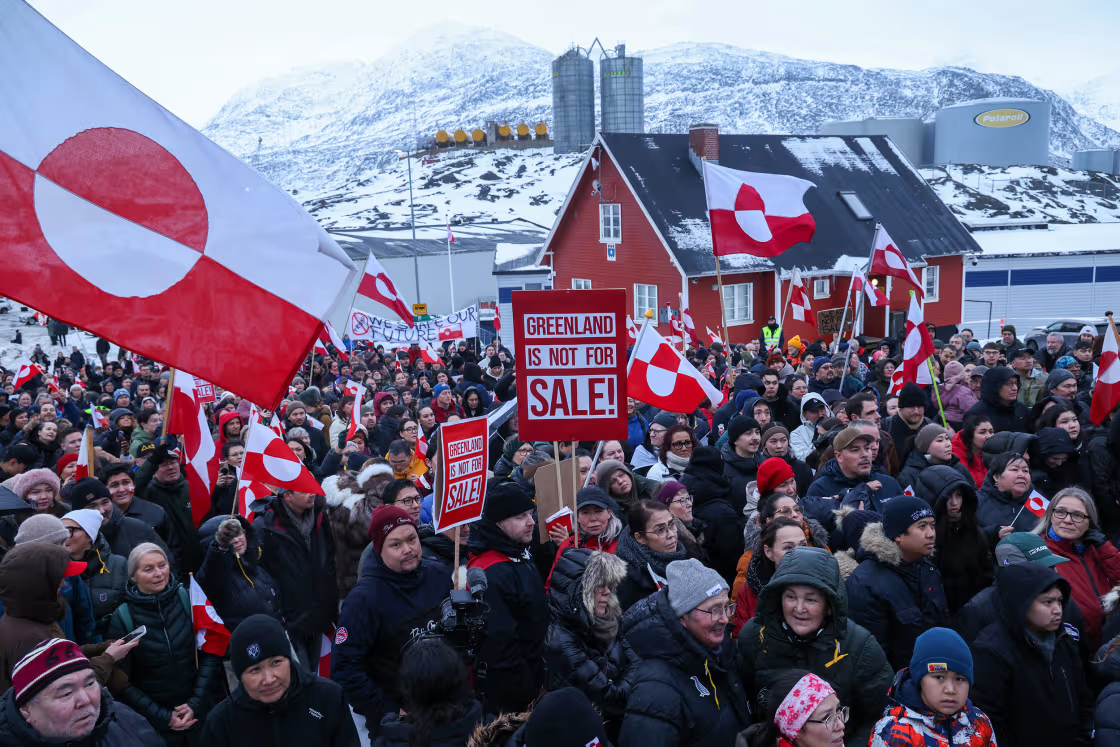 |
People hold Greenlandic flags and placards as they gather by the U.S. Consulate in Nuuk, Greenland, on Saturday to protest against Donald Trump and his announced intent to acquire Greenland.Sean Gallup / Getty Images |
This move intertwines trade policy, sovereignty disputes, and security rhetoric, triggering a wide diplomatic backlash and raising significant concerns about the future of U.S.–European relations and the broader global economic system.
Strategic Importance of Greenland in U.S. Foreign Policy
Greenland’s geopolitical value rests on its location in the Arctic, just south of the Arctic Circle and between North America and Europe. Its significance includes:
- Defense and early warning systems: Greenland hosts long-standing U.S. military infrastructure and radar installations crucial to North American defense.
- Natural resources: The island is rich in rare earth elements, minerals, and hydrocarbons — assets increasingly central to global economic competition.
- Geopolitical positioning: As the Arctic ice recedes, Greenland becomes strategically important for shipping lanes, military reach, and influence vis-à-vis Russia and China.
Trump has justified the tariff ultimatum by emphasizing these security imperatives, framing Greenland as essential to the “safety, security, and survival of our planet.”
What the Tariff Policy Entails
Tariff Structure and Targeted Nations
President Trump’s announcement sets out a two-tier tariff escalation on imports from the targeted European nations:
- 10% tariff effective February 1, 2026
- 25% tariff effective June 1, 2026
European Response: Unified Rejection and “No Blackmail” Stance
European leaders have uniformly condemned the tariff threats as coercive and harmful to transatlantic cooperation:
- Denmark and Greenland reaffirm sovereignty over the island and have rejected U.S. acquisition efforts.
- UK officials declared Greenland’s future “non-negotiable,” highlighting that the territory belongs to its people and Denmark.
- Leaders across Europe characterized the tariff ultimatum as blackmail that could fracture NATO unity and undermine decades-old alliances.
Joint military deployments by European nations in Greenland — framed as cooperative measures for Arctic security — have been cited by Trump as “provocative,” though allies argue they strengthen collective defense rather than threaten U.S. interests.
Economic and Trade Implications
Transatlantic Trade Disruption
The targeted tariffs risk derailing ongoing U.S.–EU trade negotiations and broader economic cooperation:
- The EU–U.S. trade deal negotiations have already stalled amid these disputes, with European officials unwilling to proceed under the shadow of coercive tariff tactics.
- European exports — including automobiles, machinery, pharmaceuticals, and consumer goods — face increased costs that could be passed on to American consumers and producers.
- Retaliatory tariffs by the EU on U.S. goods are a distinct possibility if tariff threats persist, risking a deeper trade war.
Market Uncertainty and Economic Risk
Analysts warn that the tariff escalation injects policy risk into global markets, potentially affecting:
- Inflation and production costs in industries reliant on European imports.
- Exchange rates and supply chains sensitive to tariff volatility.
- Investor confidence, particularly in sectors exposed to U.S.–Europe trade flows.
Diplomatic Backlash and NATO at a Crossroads
The tariff ultimatum has ignited intense debate about the future of transatlantic security cooperation:
- NATO members accused the U.S. of undermining alliance cohesion by using tariffs as leverage in a territorial dispute.
- European governments fear that such tactics could set a precedent encouraging similar coercive measures worldwide.
- Some analysts argue that this confrontation could benefit geopolitical rivals, as allied discord weakens collective deterrence.
Greenland’s leadership and Danish authorities have emphasized stronger cooperation within NATO and with the EU as the appropriate framework for Arctic security, rejecting unilateral acquisition proposals.
Conclusion: A Pivotal Moment in U.S.–European Relations
The imposition of tariffs on European nations contingent upon the transfer of Greenland marks a historic rupture in U.S.–European relations. It intertwines trade policy, sovereignty, and security rhetoric in a way that challenges the foundations of collective defense and economic cooperation.
As this situation develops:
- European nations are expected to strengthen their political and economic alliances.
- The U.S. faces growing criticism both domestically and abroad.
- The future of NATO and transatlantic trade agreements hangs in the balance.
This crisis highlights the complex interplay between geopolitical ambition and economic policy — and it will likely define the contours of Western diplomacy for years to come.



0 Comments